
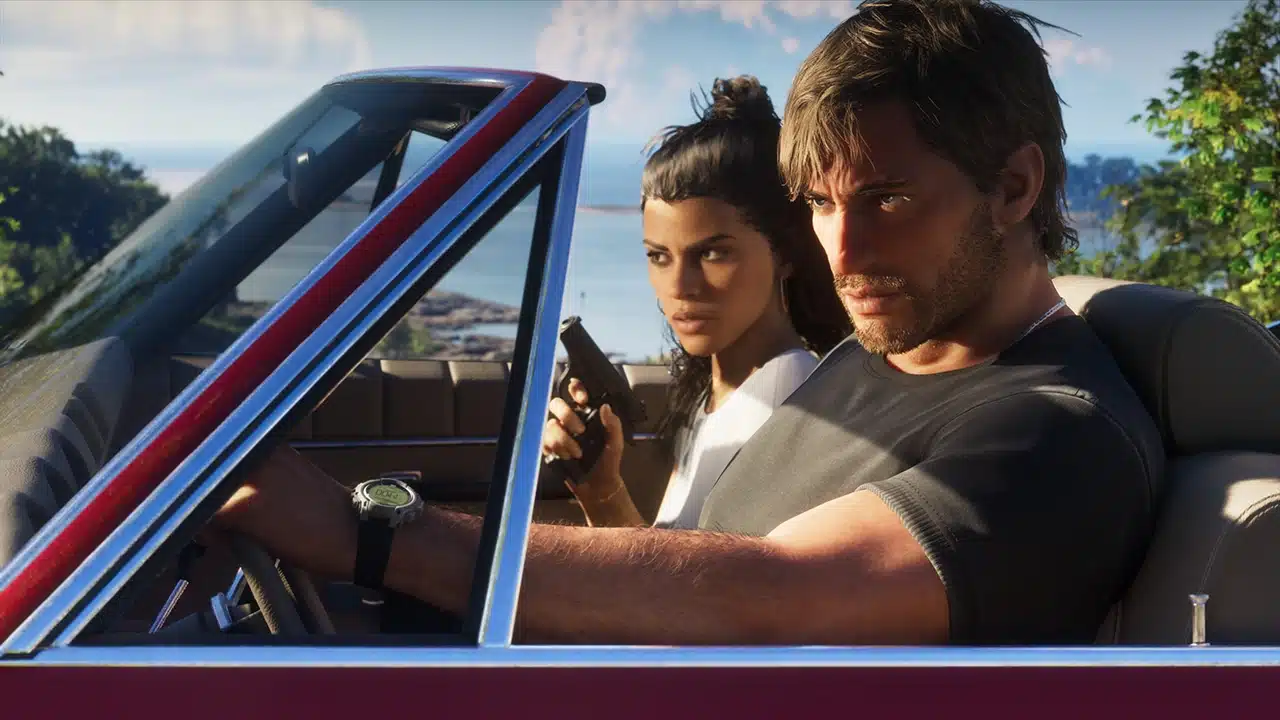
I first locked eyes on Grand Theft Auto when Vice City was on screen at a friend’s birthday party. No I wasn’t 18. Yes, I did try and convince my dad to rent it from Blockbuster the next week. So I was always going to pay attention to the launch of GTA 6 – but, 20 years on, I now have a marketer’s eyes, and I’ve found the whole thing fascinating.
Because whatever you think of the game, the way Rockstar is bringing it to market is one of the most comprehensive campaigns I’ve seen (goodness me, they’ve had time to plan it since the launch of GTA V).
A gameplay film of nearly half an hour that went to number one on Netflix. A fashion magazine cover. Around ten musicians posting cropped artwork on the same day on Instagram. Beach umbrellas in Miami.
Most of that is out of reach for most of us. If you’re a marketing team of one, or three, with a budget that wouldn’t cover the catering at Rockstar North, you aren’t going to rent a rooftop in Miami. Neither am I.
But the more I’ve looked at it, the more I think the expensive bits are the least interesting bit. Underneath them is a set of choices about restraint, timing, partners, and trust, and those cost very little. They’re what this post is about – trying to make things a bit more accessible!
So I’ve done two things alongside my mate Claude. First, gathered up everywhere Rockstar has chosen to show up. Then pulled out the principles underneath, each with a version you could run on a small budget.
Why this launch is worth studying even if you don’t have big money
Some numbers. The first trailer, in December 2023, took the record for the most-viewed non-music YouTube video in 24 hours. The second, in May 2025, was watched 475 million times across platforms in a day, according to Rockstar, against roughly 365 million for Deadpool & Wolverine.
This August’s gameplay film drew 31.1 million views on Netflix in four days and was number one in 87 of the 93 countries Netflix tracks. Sensor Tower estimates around 4.55 million pre-orders had been placed before that film even aired.
This is a proper cultural moment, propelled by a marketing campaign which has had few holds barred. And I don’t mean that in a weird marketing person making a big deal of something for the sake of it way.
Everywhere Rockstar has shown up so far
This is the record as of 17 September 2026, two months from launch. Laid out like this, what strikes me is how few things there are.
December 2023: one image, then Trailer 1. The teaser was silhouetted palm trees against a purple and orange sunset, with a date and time. The trailer leaked a day early, so Rockstar posted a one-line note pointing people to the real thing and released it. Spotify streams of Tom Petty’s Love Is a Long Road rose 36,979% week on week.
2024 to spring 2025: nothing. Almost a year and a half of silence, which Take-Two’s CEO Strauss Zelnick confirmed was part of the plan.
May 2025: Trailer 2, with no warning. Streams of The Pointer Sisters’ Hot Together rose 182,000% in two hours.
18 June 2026: cover art. A 33-second video revealed the cover and a pre-order date of 25 June, after seven months without a word about the game. Standard Edition $79.99, Ultimate $99.99.
July 2026: Edinburgh. A closed-door, hands-off preview at Rockstar North for IGN, Kinda Funny, and Dazed, plus four creators: TGG from Australia, Rubius from Spain, Davy Jones from Brazil, and MikeShowSha from Italy.
26 August: Dazed, not a games magazine. The autumn “New Idols” issue put Jason and Lucia on the cover, with portraits styled as a fashion shoot and captions crediting the game’s fictional fashion houses. The GTA cover variant sold out on pre-order.
26 August: the leak statement. More on this below.
27 August: An Extended Look. Exclusive to Netflix for six hours, then on YouTube at 9pm ET. More than 20 million views followed on Rockstar’s own channel. Sensor Tower estimates pre-orders rose 436% on the day. Spotify added all 15 featured songs to its Grand Theft Auto Radio playlist, and Captain & Tennille’s track rose 130,730% (off a base of about 194,000 lifetime streams, mind).
3 September: Sony. Two limited-edition controllers revealed at PlayStation’s State of Play, with a colour-shifting finish and palm trees moulded into the grips. £74.99, out on launch day. Sony has also put GTA 6 at the centre of its own PS5 ads, including digital billboards in Tokyo.
10 September: Miami. Miami Beach commissioners voted 4–3 to let the city manager negotiate a deal with Rockstar: branding along the beach from 15 October to 31 December, in return for at least $3 million. Terms and sites aren’t settled, and the money could go towards a football field renovation. The City of Miami approved temporary downtown banners. A giant Vice City sign on the roof of the Miami Heat’s arena is reportedly being finalised. Miami-Dade County, which Rockstar had approached about paid promotions, came back with ideas of its own: an airport welcome, branded Metromover trains, Vice City manhole covers. Officials called them preliminary and nothing has gone to a vote, but the reception was rough. The sheriff’s line was “Miami-Dade County is not Vice City”. One commissioner’s reply: “We’re not giving away pistols and cocaine to people.”
15 September: the artists. Travis Scott, Future (via his label, Freebandz), Metro Boomin, Morgan Wallen, PinkPantheress, Keith Richards, and others posted GTA-styled images on the same day. Each was a cropped, seemingly unconnected piece of artwork: Scott’s was a high heel on a pole, Future’s the back of a sports car. Keith Richards posted an iguana with no comment at all.
16 September: Spotify. Billboards in New York and Los Angeles, and Miami by some reports, carried extended versions of the same artwork with Spotify’s logo. Spotify posted them with barely a caption. No partnership has been confirmed by anyone.
Throughout: Strauss Zelnick as narrator. Every quarter, on earnings calls, explaining the silence and setting expectations.
The principles underneath, and how to run them without the budget (like most of us)
That might seem like a lot. But, set against the impact it’s having – it’s worth looking at it with curious eyes even if we don’t have the same budget. And yeah, they’re very much launching to a really warm audience – but still – what can we take from it?
Principle 1: scarcity is a choice, and it’s free
GTA V’s campaign ran for a little over 22 months. This one runs for about five. Zelnick’s explanation was that releasing material close to launch keeps excitement high, balanced against what he called “unmet anticipation”.
Most of us do the opposite. We post because it’s Tuesday.
On a small budget: fewer, better moments. If you’ve got one properly good thing to say this quarter, say that well, rather than twelve things nobody asked for. Your brand isn’t about saying more – it’s about saying what only you can say.
The caveat: silence only builds anticipation if somebody is already waiting. Rockstar has nearly three decades of equity. If nobody’s waiting for you yet, going quiet is just being quiet. Striking the balance is an act of taste and application – but it’s one for you to make, moderated by the quesion ‘what can only we say?’.
Principle 2: awareness isn’t enthusiasm
Zelnick says investors have asked whether GTA 6 needs a marketing budget at all, given its reach. Let’s ignore the difference between ‘marketing’ and ‘advertising’ for now. His answer was “awareness is one thing; enthusiasm is another thing”. Even a globally known property has to go out and create a feeling, and has to show people what they’re going to get.
So the centrepiece was nearly half an hour of the product being used, rather than another cinematic trailer. It was cool to see. I watched too.
On a small budget: your customers knowing you exist isn’t the same as them being excited about what’s next. Show the thing. A proper demo, a walkthrough, a customer using it on camera. It’s the cheapest content you can make and usually the most persuasive.
Principle 3: borrow the other person’s room by giving value
Netflix rather than a games showcase. It was Rockstar that pitched Netflix. Other inclusions were in Dazed, a British art, culture, and style magazine, rather than the games press that carried previous instalments. Spotify too.
Each is an audience adjacent to the core: people who might well buy the game but don’t read games media. The cost to the core was a six-hour wait, and some fans didn’t love the footage sitting behind a paywall first. .
On a small budget: who already has the attention of the people just outside your usual reach? A newsletter, a podcast, a trade body, a community (ahem). Offer them something that’s theirs first, such as an early look, a piece of data, or a story, for a short window. Exclusivity is a currency even when money isn’t.
Principle 4: let other people tell it, but give them something true to tell
A couple of weeks ahead of the trailer launch, a series of creators were invited behind the scenes to watch even more footage.
Each creator in Edinburgh was shown the game separately, with studio co-head Rob Nelson at the controls asking where they wanted to go. Four different sessions, so four different videos rather than one video four times. The embargo lifted with the Netflix premiere. Rockstar also cleared everyone else to post reactions, clips, and breakdowns.
Each posted a series of videos. Each video posted received millions of views themselves.
Zelnick’s view is that paying a creator to praise something weak doesn’t work, because their credibility is the value of the endorsement.
On a small budget: invite five customers or niche creators behind the scenes. Give each something different. Be clear about what they can share and when. Then don’t script them.
Principle 5: sequence small things so they add up
Look at this week as of writing. Tuesday: around ten musicians post cropped artwork with barely a caption. Wednesday: the same artwork, uncropped, on billboards in at least two cities. Each piece is small. In sequence, each explains the last and sets up the next. The Dazed cover landed the day before Netflix. The controllers came the week after.
On a small budget: timing is free. Land your email, your partner’s post, your event, and your customer story in the same week, rather than dribbling them across a quarter.
Principle 6: build assets people recognise with your name taken off – a masterclass in distinctiveness
Under the Miami Beach proposal, the words “Grand Theft Auto” wouldn’t appear. Just “VI” and Vice City iconography, on beach chairs and umbrellas. The artists’ posts carried no logo either. A cropped corner of an illustration was enough.
That’s what years of consistent distinctive assets buys you: the sunsets, the palm trees, the illustration style, the numerals. Jenni Romaniuk’s work on this is the place to go deeper.
On a small budget: pick your colours, shapes, a phrase, a style of photography, and hold your nerve for years. The test: cover the logo. Would a customer still know it’s you? You WILL get bored of your branding and message before your customers will. Ritson points to a 30 year period of investment before you can start messing with them.
Principle 7: leave gaps for people to fill (if you have enough brand equity)
A cropped image is a puzzle. Travis Scott’s caption and image seemed to hint at an in-game club, and his music has been in GTA since 2013. When TGG announced his Edinburgh trip, Rockstar’s account replied with a gorilla and a heart.
On a small budget: people support what they help build. Give your community raw material and a reason to talk to each other, not just to you.
Principle 8: when it goes wrong, be a person
The week before the Netflix premiere, leaked gameplay spread online. Rockstar’s statement apologised for how long everything had taken and thanked the community for its messages of support. It called the leaks “heartbreaking”. Then, the next day, the plan carried on exactly as scheduled.
On a small budget: you won’t control everything either. Short, human, and then back to the plan.
The part I find most fascinating: my wife isn’t into gaming, and this is passing her by
For all of that, it’s entirely possible to live a full and happy life in 2026 without having encountered any of it. Plenty of sharp marketers I’ll talk to this week won’t have seen a single trailer. No Travis Scott post. No argument in Miami about beach umbrellas. It went straight over their heads.
If you’re not a gamer – you might have missed all this.
We talk a lot about fragmented culture. I’m not sure I’ve seen a cleaner example. What’s widely expected to be the biggest entertainment launch of the decade is a shared event for some people and invisible to everyone else.
That isn’t a failure of reach. Rockstar isn’t trying to reach everyone. It’s trying to reach everyone who might ever buy a game, which is a different and far more achievable thing. It’s also perfectly consistent with Byron Sharp: reach all category buyers. Just be clear about where your category ends.
The culture bit is what happens inside that boundary. “We got X before GTA 6” became a meme for the long wait. Fans spent late 2024 trying to predict the second trailer from the phase of the moon in a GTA Online promotional image. From outside it looks like madness. From inside it’s belonging. That’s how marketing builds a subculture: shared jokes, shared rituals, shared detective work, and a brand that speaks to those people very strongly while being perfectly relaxed about everyone else.
Principle 9: you don’t need everyone. You need to matter a great deal to someone
On a small budget: this one’s easier for you than it is for Rockstar. You can’t afford to reach everyone anyway. Being invisible to people who’d never buy from you isn’t a weakness. Define the edges of your category, then go deep with the people inside it.
This isn’t only a launch campaign
GTA V has passed 230 million copies and has routinely sold around five million a quarter, 13 years on. One running tally of Take-Two’s filings puts franchise net revenue since 2013 above $10 billion, with GTA Online around half of it.
So November isn’t the finish line. The proposed Miami Beach deal runs to 31 December, six weeks past launch. Rockstar describes the next GTA Online as a closely guarded secret. What’s being built is a place in culture that can carry a platform for a decade or more.
It’s Binet and Field’s long and short, done at once. The pre-order spike is the short. Vice City as somewhere people want to be is the long.
Principle 10: market the next ten years, not just the next ten weeks
On a small budget: ask of your next launch, what does this need to make true in three years, not just this quarter?
What doesn’t transfer
Rockstar’s restraint sits on top of a product people already love. Zelnick is blunt that marketing can sell a great game to more people but can’t rescue a bad one. None of this is a substitute for being good.
And showing up in culture means culture answers back. Miami’s 4–3 vote is a reminder that not everyone wants to be part of your moment.
Practical stuff to do as a result
- Cut one routine piece of content and put the time into one thing worth waiting for.
- List three “rooms next door” and what you could offer each of them first.
- Put your next launch’s moving parts in one week on one calendar.
- Cover your logo on your last five pieces of work. See what’s left.
- Write down who you’re happy to be invisible to.
The expensive bits are the least interesting
I started taking notes on this as a gamer who couldn’t help himself. What I’ve ended up with is a list where almost nothing on it needs Rockstar’s money. Restraint is free. Timing is free. Showing the product is nearly free. Being generous with partners and fans costs a bit of nerve, and not much else.
The rooftop in Miami is just what those choices look like with a very large budget attached.